As organizations continue to adopt agile practices, it’s important to understand the differences between financing a traditional waterfall project and an agile product. In this post, we will compare and contrast these two approaches and explain why they can lead to different outcomes.
Hashtag#Waterfall projects are typically funded in a linear fashion, with a fixed budget allocated up front. This budget is used to plan and execute the project, and it is often divided into fixed phases or milestones. This approach is based on the idea that the project scope, requirements, and schedule can be defined and agreed upon at the start of the project, and that the project can be executed in a predictable and linear fashion.
Hashtag#Agile products, on the other hand, are typically funded in an iterative and incremental fashion. Instead of a fixed budget, the funding is provided in small increments, typically at the end of each iteration or sprint. This allows the product team to adjust the scope, priorities, and schedule based on feedback and changing business needs. The agile product is delivered in a series of small increments, with each increment adding value and building on the previous ones. The bottom line is that you finance a Hashtag#crossfunctional team that develops and maintains the product in this case.
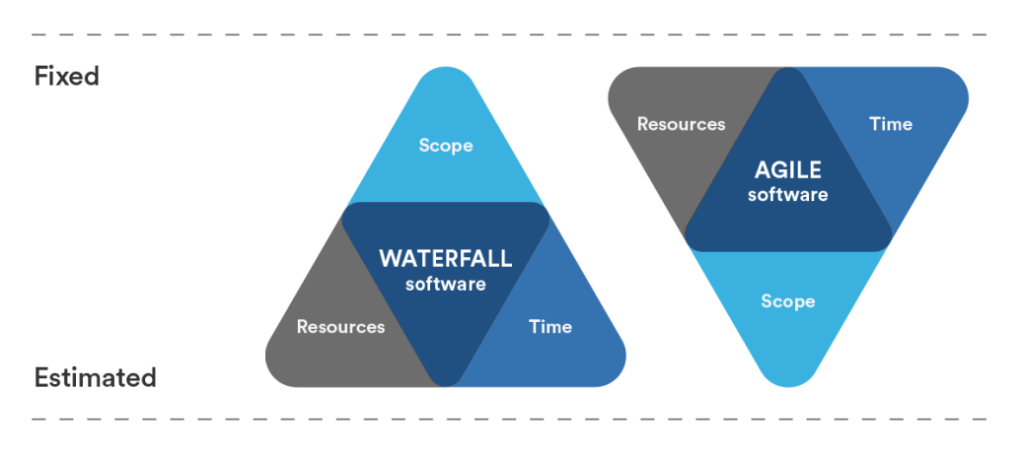
There are several key differences between financing a waterfall project and an agile product.
- First, the waterfall approach requires a larger upfront investment, while the agile approach allows for more flexibility and adaptability.
- Second, the waterfall approach is based on a fixed scope and schedule, while the agile approach allows for more iteration and experimentation.
- Third, the waterfall approach is more risky, since it is based on a set of assumptions that may not hold true over the course of the project.
Overall, financing a waterfall project and financing an agile product are two very different approaches, and it’s important to choose the right one based on your specific needs and goals. While the waterfall approach may be suitable for some projects, the agile approach can provide more flexibility and adaptability in an ever-changing business environment.
 Empowering Transformation
Kommentar verfassen